
24 oz to ml: Accurate Conversion, Formula & Bottle Size
Convert 24 oz to ml with the correct US or UK measurement. See the formula, a handy conversion chart, and what a 24-ounce bottle holds in milliliters and liters.
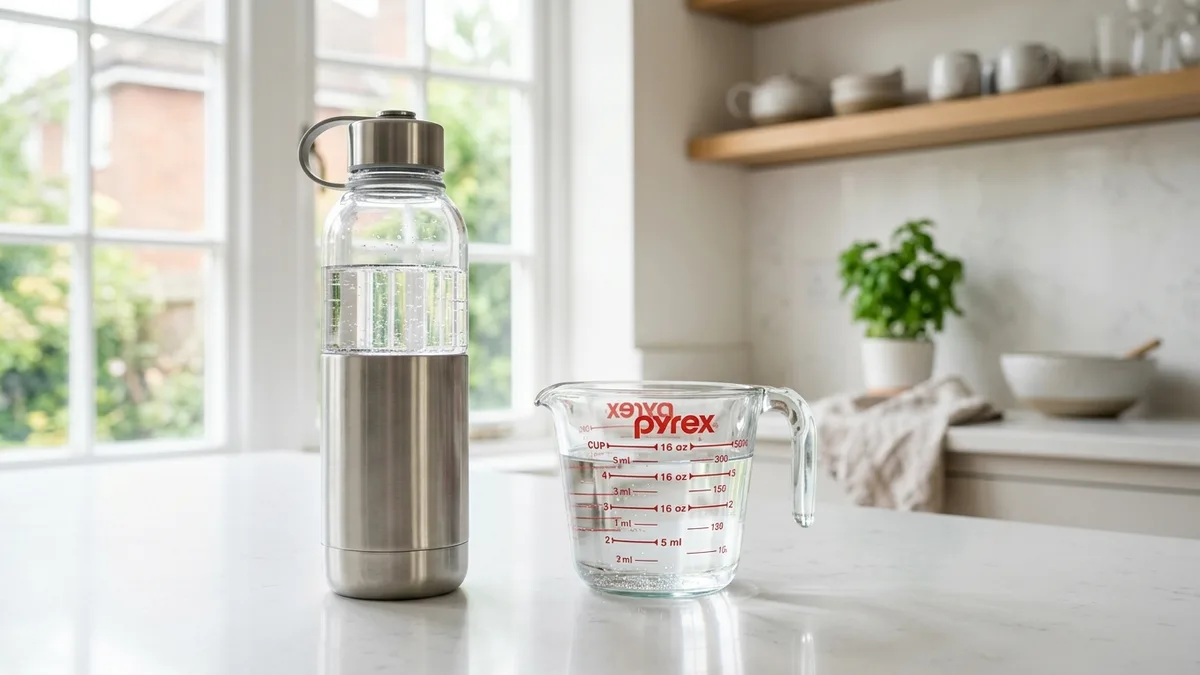
Table of Contents
17 sections24 US fluid ounces equal approximately 709.76 mL, or 710 mL rounded to the nearest milliliter. For a standard US liquid-volume conversion, that is the answer to 24 oz to ml.
The detail to check is what “oz” means on your bottle, measuring jug, or recipe. A US fluid ounce and an imperial fluid ounce hold different amounts. An ounce measured on a kitchen scale is a weight unit, so it needs a different calculation altogether.
For a bottle marked 24 US fl oz, use about 710 mL when comparing capacity. For a recipe that needs a more precise measurement, keep the decimal value until you finish calculating. The steps below explain the conversion and how to choose the right value for your situation.
Quick Answer
| Measurement system | Volume of 24 fluid ounces |
|---|---|
| US customary | Approximately 709.76 mL |
| Imperial | Approximately 681.91 mL |
Both answers describe liquid volume. Choose the row that matches the original measurement; the difference comes from the size of the fluid ounce in each system.
How to Calculate 24 oz to ml
To convert US fluid ounces to milliliters, multiply the number of fluid ounces by 29.5735295625.
mL = US fl oz × 29.5735295625
Here, “US fl oz” is the starting volume, and “mL” is the equivalent volume in milliliters. Substituting 24 gives:
24 × 29.5735295625 = 709.7647095 mL
Rounded to two decimal places, the result is 709.76 mL. Rounded to a whole milliliter, it becomes 710 mL.
If you use an oz to ml converter, select US fluid ounces as the input unit, enter 24, and choose milliliters as the output. Check the unit setting before relying on the result, especially if the calculator also offers imperial measurements.
What Does That Mean for a 24-Ounce Bottle?
A bottle with a stated capacity of 24 US fl oz has a nominal volume of about 710 mL. That is slightly less than three-quarters of a liter.
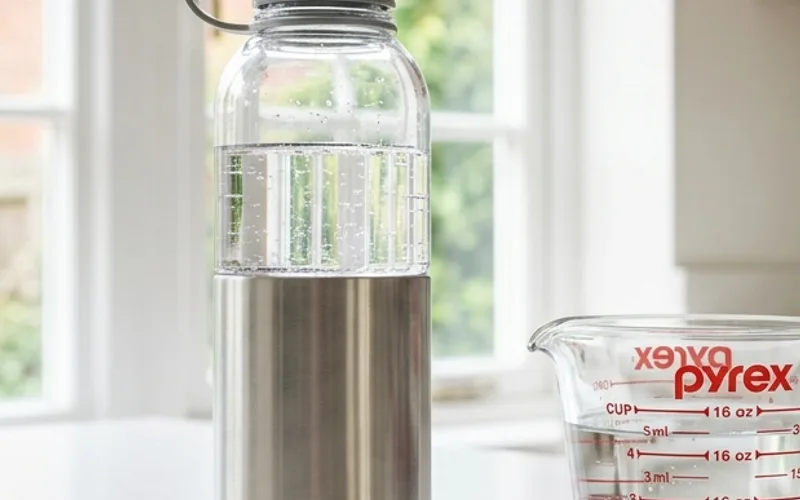
Suppose you want to transfer a 750 mL drink into it. The drink exceeds the bottle’s stated capacity by approximately 40.24 mL, so you would need to leave some behind. A 750 mL container and a 24 US fl oz container are close in size, but they are not interchangeable for an exact measurement.
Also distinguish capacity from the amount currently inside. A half-full bottle contains only about half its stated volume. Ice, fruit, or other additions occupy space too, reducing how much liquid you can pour in.
When comparing products, use the manufacturer’s capacity specifications. When measuring an ingredient, use the markings on a suitable measuring jug rather than estimating from the bottle’s shape.
Why the Imperial Answer Is Different
An imperial fluid ounce equals 28.4130625 mL, while a US fluid ounce is approximately 29.57353 mL. The imperial unit is smaller, so 24 imperial fluid ounces represent less liquid.
For an imperial measurement, the calculation is:
24 × 28.4130625 = 681.9135 mL
That rounds to 681.91 mL, or about 682 mL. The difference between the two 24-fluid-ounce measurements is roughly 27.85 mL.
Look for “US fl oz,” “imperial fl oz,” or an explanation of the units in the recipe or product specifications. A product being sold in the UK does not, by itself, establish that its ounce capacity uses imperial units. Check the stated system instead of choosing one based only on where you bought it.
Nearby Bottle Sizes in Milliliters
This conversion chart uses US fluid ounces throughout. Values are rounded to two decimal places.
| US fluid ounces | Milliliters |
|---|---|
| 16 fl oz | 473.18 mL |
| 20 fl oz | 591.47 mL |
| 24 fl oz | 709.76 mL |
| 28 fl oz | 828.06 mL |
| 32 fl oz | 946.35 mL |
Use the table to compare container capacities on the same basis. For example, moving from a 20-ounce bottle to a 24-ounce bottle adds about 118.29 mL of capacity.
Check Whether “Ounces” Means Volume or Weight
Before converting 24 ounces to ml, check how those ounces were measured.
Fluid ounces measure volume: the amount of space something occupies. Weight ounces describe mass. A liquid measuring jug and a kitchen scale therefore provide different kinds of measurements, even when both display an ounce-related unit.
If a recipe specifies 24 ounces of an ingredient by weight, you cannot apply the fluid-ounce conversion factor. You need the ingredient’s density to convert its mass into volume:
Volume (mL) = mass (g) ÷ density (g/mL)
This distinction matters for ingredients such as honey, oil, and flour. Equal weights do not necessarily occupy equal volumes. By contrast, 24 US fluid ounces always describe the same volume, regardless of which substance fills that space.
Planning Refills With a 24 oz Water Bottle
A bottle’s capacity can help you estimate how much water you have carried or poured. It does not, by itself, tell you how much you personally need to drink. For volume tracking, count the amount actually used rather than counting every refill as another completely empty bottle.
For example, two full 24 US fl oz bottles contain approximately 1,419.53 mL, or 1.42 L. Three contain about 2,129.29 mL, or 2.13 L. These totals assume each bottle starts full and all the liquid is used.
Suppose you finish one full bottle, refill it, then drink half of the second fill. Your total is one and a half bottlefuls: 36 US fl oz, approximately 1,064.65 mL. Recording two full bottlefuls would overstate the amount by half a bottle.
A bottle with readable graduations makes partial amounts easier to track. If it has no markings, use halves or quarters only as rough estimates. A tapered bottle does not necessarily hold half its volume when the liquid reaches half its height.
Fractions of the stated capacity
| Fraction of a 24 US fl oz bottle | US fluid ounces | Approximate milliliters |
|---|---|---|
| One quarter | 6 | 177.44 |
| One half | 12 | 354.88 |
| Three quarters | 18 | 532.32 |
| Completely full | 24 | 709.76 |
These fractions refer to volume, not the position of a line on the outside. If you want to mark a reusable bottle yourself, add measured amounts of water with a graduated jug and mark each level. That establishes useful reference points for that particular container, although it does not turn the bottle into precision measuring equipment.
Comparing a 24 oz Bottle With 700 mL and 1 Liter
The closest convenient metric description is approximately 710 mL. A 700 mL bottle is about 9.76 mL smaller than the stated 24 US fl oz capacity. That difference is modest for shopping comparisons, but it explains why two bottles described as similar sizes may not hold identical amounts.
A 1 liter bottle holds about 290.24 mL more than a 24 US fl oz bottle. In percentage terms, the 24-ounce size holds roughly 71% of a liter. If you are replacing a liter bottle and want the same total capacity, the smaller bottle would need an additional partial refill.
Size also affects how you compare products sold by volume. If a hypothetical 700 mL drink costs $3.50 and a 24 US fl oz drink costs $3.60, calculate the price per 100 mL for both. The first costs $0.50 per 100 mL; the second costs about $0.51 per 100 mL. The example is arithmetic, not a claim about actual retail prices.
Using a common metric basis avoids judging value from the larger printed number. A label displaying “24” and another displaying “700” cannot be compared numerically until their units match.
Measuring 24 Fluid Ounces Without a 24 oz Line
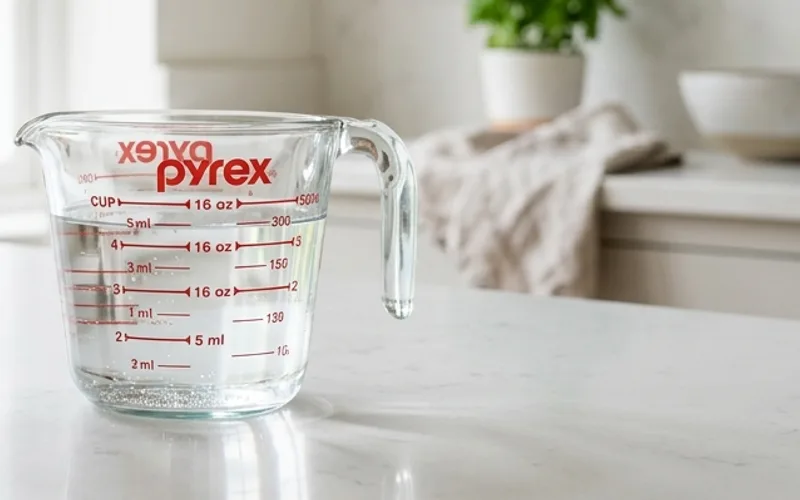
You can build the quantity from smaller measures as long as they all use the same system. A 16 US fl oz measure plus an 8 US fl oz measure gives exactly 24 US fl oz. Two 12 US fl oz measures work too.
For a metric-only jug, aim for approximately 710 mL when a whole-milliliter approximation suits the recipe. If the jug stops at 500 mL, measure 500 mL first and then approximately 210 mL. The combined volume is the rounded target, so there is no need to find a separate ounce-marked vessel.
Use a container large enough to hold both additions. Mark the first quantity on paper or keep the second measure beside the jug until it has been added. When you are interrupted halfway through measuring, it is easy to confuse a planned second pour with one already completed.
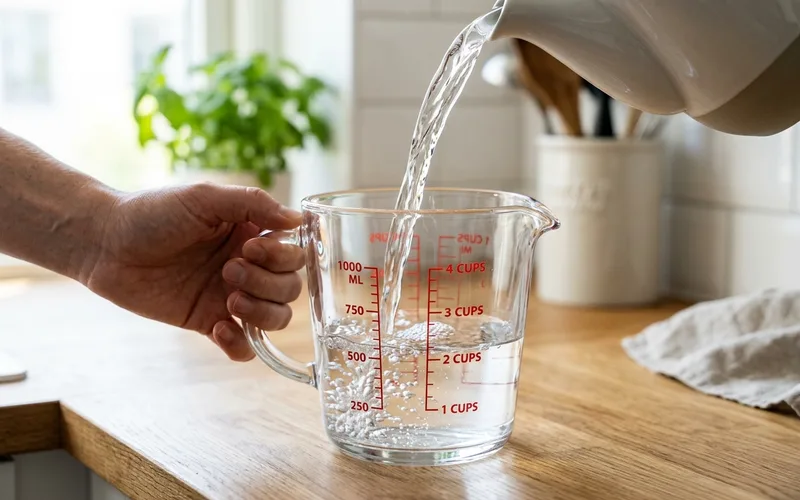
For a clear liquid, place the jug on a flat surface and read the level at eye height. A broad jug with sparse graduations may be suitable for a rough drink mixture but less useful for a carefully measured recipe. Choose the scale that lets you read the intended amount directly.
Why the Final Digits Should Not Control Your Pour
The calculated value 709.7647095 mL comes from the unit definition. It does not imply that a consumer bottle has been checked to a tiny fraction of a milliliter. The conversion can be exact while the real-world fill remains approximate.
Round according to what you are doing. For a product comparison, 710 mL is usually easier to understand. For a conversion table, 709.76 mL shows the relationship more clearly. For a multi-bottle calculation, retain the full factor during the arithmetic, then round the combined result once.
Avoid repeatedly converting a rounded number back and forth. Starting with 710 mL and converting back will give slightly more than 24 US fl oz because you changed the original amount during rounding. That small difference is expected and does not indicate a broken converter.
Frequently Asked Questions
What is 24 oz of water in ml?
If the measurement means 24 US fluid ounces of water, it is approximately 709.76 mL. Water does not need a special conversion factor when the starting unit already measures volume. If you weighed 24 ounces of water on a scale, that is a mass measurement and requires a density-based conversion.
How much is 24 oz in ml and liters?
24 US fluid ounces equal approximately 709.76 mL or 0.70976 liters. Divide the milliliter value by 1,000 to express it in liters. For a simple bottle-size comparison, you can use about 710 mL or 0.71 L; both are rounded versions of the same volume.
Why do I sometimes get 720 mL?
Multiplying by a simplified factor of 30 mL per fluid ounce gives 720 mL. That is about 10.24 mL above the standard US customary conversion for 24 fluid ounces. For this calculation, use the more precise factor rather than rounding each fluid ounce before multiplying.
How can I measure 24 fluid ounces with cups?
Using a US customary measuring cup of 8 US fluid ounces, 24 fluid ounces equal exactly three cups. Check your cup size first: three 250 mL metric cups hold 750 mL, which exceeds the target. A measuring jug with milliliter markings can help avoid mixing cup standards.
Choose the Value That Matches Your Units
For everyday US bottle comparisons, remember 24 oz to ml is approximately 710 mL. Use 709.76 mL when two decimal places are useful, and select the imperial calculation only when the original measurement uses imperial fluid ounces. Checking the unit first makes the rest a straightforward multiplication.
Oz to mL Editorial Team
Verified EditorialWritten and verified by our culinary and scientific measurement specialists. All formulas, charts, and conversions strictly reference NIST standard US Customary and Metric SI units.
Convert Fluid Ounces & Milliliters Instantly
Need quick calculations for cooking, hydration tracking, or chemistry? Our free converter updates in real time with high decimal accuracy.
Related Conversion Guides
 Bottle Conversions
750 ml to oz: US Fluid Ounces, UK Ounces & Bottle Size
Convert 750 ml to oz accurately: 25.36 US fluid ounces or 26.40 UK imperial fluid ounces. See the formula, rounding, cups, and bottle portions.
 Bottle Conversions
600 ml to oz: Is a 600 mL Bottle the Same as 20 oz?
Convert 600 ml to oz: 20.29 US fluid ounces. Compare it with a 20 oz bottle, check imperial ounces, and find the right cup measurement for your recipe.
 Reference Charts
Unit Conversion Chart for Everyday Measurements and Math
Use this unit conversion chart for length, weight, volume, area, speed, and temperature, with metric and US measurements, clear formulas, and worked examples.