
750 ml to oz: US Fluid Ounces, UK Ounces & Bottle Size
Convert 750 ml to oz accurately: 25.36 US fluid ounces or 26.40 UK imperial fluid ounces. See the formula, rounding, cups, and bottle portions.
Table of Contents
18 sections750 ml to oz equals approximately 25.36 US fluid ounces, commonly rounded to 25.4 fl oz on a bottle or in a conversion chart. If you mean UK imperial fluid ounces, the same 750 mL is about 26.40 imperial fl oz. The liquid amount does not change; the two systems define a fluid ounce differently.
This question often comes up while reading a bottle label, comparing container sizes, or planning how much liquid a recipe needs. The main thing to check is the word fluid. Milliliters measure volume, so the matching ounce unit is a fluid ounce (fl oz). Ounces shown on a scale measure mass and require information about the substance.
Here is the exact calculation behind the US answer, followed by useful ways to picture 750 mL and avoid a misleading result from a converter.
The Conversion in One Line
For US fluid ounces, divide the milliliter amount by the volume of one US fluid ounce:

US fl oz = mL ÷ 29.5735295625
750 ÷ 29.5735295625 = 25.360517… US fl oz
That is 25.36 US fl oz to two decimal places. Rounded to one decimal place, it becomes 25.4 US fl oz. Both refer to a 750 mL volume; the shorter figure is simply less precise.
Use 25.36 when calculating another amount from the bottle. Use 25.4 when a one-decimal estimate is enough. Avoid treating a rounded display as a promise that a bottle contains exactly 25.4 fluid ounces down to the last drop.
Why UK Conversion Tools Show 26.40 oz
One imperial fluid ounce is smaller than one US fluid ounce. Dividing the same 750 mL volume by the imperial unit gives a larger number:
750 mL ÷ 28.4130625 mL per imperial fl oz ≈ 26.40 imperial fl oz
| System selected | 750 mL expressed in fluid ounces |
|---|---|
| US customary | 25.36 US fl oz |
| UK imperial | 26.40 imperial fl oz |
Check a converter’s US or imperial setting before entering the number. A search result that says only “26.4 oz” may be using the imperial unit; that figure is not the US fluid-ounce equivalent.
What Does 750 mL Look Like in Other Volume Units?
If fluid ounces are unfamiliar, these equivalents can help when choosing a jug, measuring cup, or storage container:
| Unit | Equivalent to 750 mL |
|---|---|
| Liters | 0.75 L |
| US fluid ounces | 25.36 fl oz |
| US customary cups | About 3.17 cups |
| Portions of 250 mL each | 3 portions |
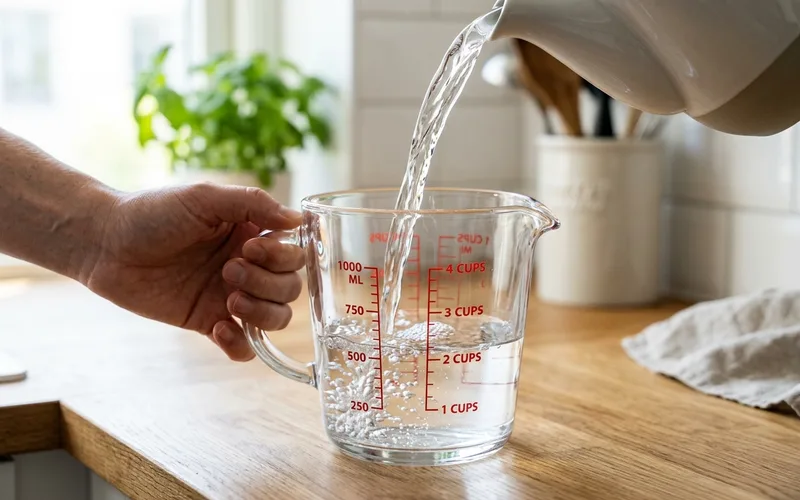
The cup figure uses a US customary cup, approximately 236.59 mL. Three such cups hold about 709.76 mL, leaving roughly 40.24 mL of the 750 mL amount. By contrast, three portions measured at 250 mL each use it exactly.
That makes 0.75 L the simplest metric shorthand. It expresses the same volume without rounding or choosing a national fluid-ounce system.
Dividing a 750 mL Bottle Into Portions
For a fixed number of equal portions, divide 750 mL by the number of portions first. Convert an individual portion to fluid ounces afterward if needed.
For example, five equal portions are:
750 mL ÷ 5 = 150 mL per portion
150 mL ÷ 29.5735295625 ≈ 5.07 US fl oz per portion
If you measured exactly 5 US fl oz each time, five portions would use about 739.34 mL, leaving around 10.66 mL. The difference comes from rounding each portion before multiplying it back. Keeping the original 750 mL figure until the final step avoids that small discrepancy.
These are volume examples; the arithmetic works for any liquid sold in a 750 mL container.
Compare Nearby Bottle Sizes
This chart uses US fluid ounces throughout, rounded to two decimal places. It can help when two products list their volumes in different units.
| Bottle volume | US fluid ounces |
|---|---|
| 250 mL | 8.45 fl oz |
| 500 mL | 16.91 fl oz |
| 700 mL | 23.67 fl oz |
| 750 mL | 25.36 fl oz |
| 1,000 mL | 33.81 fl oz |
Notice that a 750 mL bottle holds 50 mL more than a 700 mL bottle. The difference is about 1.69 US fl oz. Read the milliliter amounts on both labels when comparing capacity; rounded ounce labels can make small differences harder to see.
When “oz” Means Weight Instead
A milliliter is a volume unit. A plain ounce on a scale is a mass unit, so 750 mL does not have one universal weight-ounce answer. The mass depends on what fills that volume and, for a more precise result, its density at the measurement conditions.
Using water at an assumed density of 1 g/mL as a kitchen estimate, 750 mL has a mass near 750 g. Since a standard weight ounce is about 28.35 g, that works out to roughly 26.46 oz by weight. The bottle itself would add further mass.
That number should not replace 25.36 US fl oz on a volume chart. One describes approximately how much the water weighs; the other describes how much space it occupies. For another liquid, use its density or weigh the measured 750 mL directly.
How Many Pours Can You Get From 750 mL?
The number of pours depends on the volume you choose for each one. A bottle size does not establish a universal glass size. For a liquid measured in US fluid ounces, divide the bottle’s approximately 25.36 fl oz by your intended pour.
| Chosen pour | Complete pours from 750 mL | Approximate liquid left |
|---|---|---|
| 3 US fl oz | 8 | 40.24 mL |
| 4 US fl oz | 6 | 40.24 mL |
| 5 US fl oz | 5 | 10.66 mL |
| 6 US fl oz | 4 | 40.24 mL |
The repeated remainder in several rows is intentional: eight three-ounce pours, six four-ounce pours, and four six-ounce pours each use 24 US fluid ounces. These are arithmetic examples rather than serving recommendations.
If you are dividing the bottle among a known number of glasses and want equal amounts, work in milliliters first. Six equal portions are 125 mL each. Four equal portions are 187.5 mL each. This uses the whole nominal volume without treating an arbitrary rounded ounce amount as an exact portion.
Real pouring introduces small losses and differences between glasses. Use a marked measure if equal portions matter; otherwise, keep the calculated count as a planning estimate.
Scaling From One Bottle to Several
For more than one 750 mL bottle, multiply the original milliliter volume before rounding to ounces. Two bottles contain 1,500 mL, three contain 2,250 mL, and four contain 3,000 mL.
Three bottles therefore provide approximately 76.08 US fl oz. Multiplying a rounded label value of 25.4 by three instead gives 76.2 fl oz. The difference is small, but it comes entirely from rounding the individual bottle value before calculating the total.
If a recipe calls for 2 liters of a liquid sold in 750 mL bottles, two bottles are insufficient because they provide only 1.5 liters. Three provide 2.25 liters, leaving 250 mL after the recipe amount is measured. You can reach that result entirely in metric units without an ounce conversion.
The useful unit is the one that makes the decision easiest. Convert to fluid ounces when that is what your recipe or measuring tool uses; keep milliliters when the purchase and recipe already share them.
Comparing Two Bottles by Price per 100 mL
When products come in different sizes, converting the capacity is only the first step. A common unit price lets you compare their cost on the same volume basis.
Suppose a hypothetical 750 mL bottle costs $9, while a 1 liter bottle costs $11. Divide each price by its milliliters, then multiply by 100. The smaller bottle costs $1.20 per 100 mL; the larger costs $1.10 per 100 mL.
This comparison assumes the products are otherwise suitable alternatives. It does not account for ingredients, quality, waste, or how much you actually need. It simply prevents the total purchase price from being mistaken for the price of an equal quantity.
If one product lists only US fluid ounces, convert that capacity to milliliters first. If it lists both units, use the printed metric amount so you are not adding another rounding step unnecessarily.
Matching a Storage Container to the Bottle
A container labeled exactly 25 US fl oz holds approximately 739.34 mL, slightly less than 750 mL. A nominally similar-looking container may therefore leave a small amount behind when you transfer the bottle.
For storage, check the usable fill level as well as the advertised capacity. Space taken up by a lid insert or other contents is not available for the liquid. A container that reaches its stated capacity only at the brim may be inconvenient to close or move when filled that high.
Choose capacity with the intended use in mind. Storing a plain liquid, mixing additional ingredients, and adding ice do not require the same free space. The conversion establishes the initial liquid volume; the rest depends on what else must fit into the vessel.
Keep the original 750 mL label available until the transfer is complete. It provides a clear reference if the receiving container has only approximate or unfamiliar graduations.
Frequently Asked Questions
Is 750 mL 25 oz or 26 oz?
In US fluid ounces, 750 mL falls between them at approximately 25.36 fl oz. Rounding to a whole US fluid ounce gives 25 fl oz because 0.36 is below 0.5. In imperial fluid ounces, it is about 26.40 fl oz. State the system and the rounding level to make the answer clear.
Why does my bottle say 25.4 fl oz?
The label rounds the US conversion to one decimal place. 25.4 US fl oz is the standard short form of the more precise 25.36 US fl oz result for 750 mL. The US Alcohol and Tobacco Tax and Trade Bureau also lists 750 mL as 25.4 fluid ounces in its conversion table.
How many 8 oz cups are in 750 mL?
An 8 US fl oz cup holds approximately 236.59 mL. Dividing 750 by that amount gives about 3.17 US customary cups. If you mean a differently sized metric cup, use its stated milliliter capacity instead of assuming the cup holds 8 US fluid ounces.
Is 750 mL three-quarters of a liter?
Yes. One liter contains exactly 1,000 mL, and 750 ÷ 1,000 = 0.75. Therefore, 750 mL is 0.75 L, or three-quarters of a liter. This statement is exact because it converts between two metric volume units.
Does the type of liquid change the fluid-ounce answer?
No. 750 mL of water, oil, or another liquid always occupies 25.36 US fl oz when converted as volume. The liquid type affects what that amount weighs, which is a separate conversion involving density.
Can I use 30 mL for every fluid ounce?
You can use 30 mL per US fl oz for a quick estimate: 750 ÷ 30 = 25 fl oz. It understates the more precise answer of 25.36 US fl oz. For bottle comparisons or calculations that need a closer figure, use 29.5735295625 mL per US fluid ounce.
Which Figure Should You Remember?
For an everyday US bottle comparison, remember 750 ml to oz is about 25.4 US fl oz. Use 25.36 US fl oz when you need two decimal places, or 26.40 imperial fl oz when the source specifies the UK system. Keep “fluid” in the unit so the answer remains a volume measurement.
Oz to mL Editorial Team
Verified EditorialWritten and verified by our culinary and scientific measurement specialists. All formulas, charts, and conversions strictly reference NIST standard US Customary and Metric SI units.
Convert Fluid Ounces & Milliliters Instantly
Need quick calculations for cooking, hydration tracking, or chemistry? Our free converter updates in real time with high decimal accuracy.
Related Conversion Guides
 Bottle Conversions
24 oz to ml: Accurate Conversion, Formula & Bottle Size
Convert 24 oz to ml with the correct US or UK measurement. See the formula, a handy conversion chart, and what a 24-ounce bottle holds in milliliters and liters.
 Bottle Conversions
600 ml to oz: Is a 600 mL Bottle the Same as 20 oz?
Convert 600 ml to oz: 20.29 US fluid ounces. Compare it with a 20 oz bottle, check imperial ounces, and find the right cup measurement for your recipe.
 Reference Charts
Unit Conversion Chart for Everyday Measurements and Math
Use this unit conversion chart for length, weight, volume, area, speed, and temperature, with metric and US measurements, clear formulas, and worked examples.