
1 oz Liquid: How Much It Is and How to Measure It Easily
Measure 1 oz liquid with confidence. Find its equivalent in mL, tablespoons, teaspoons, and cups, plus practical tips for getting small liquid amounts right.
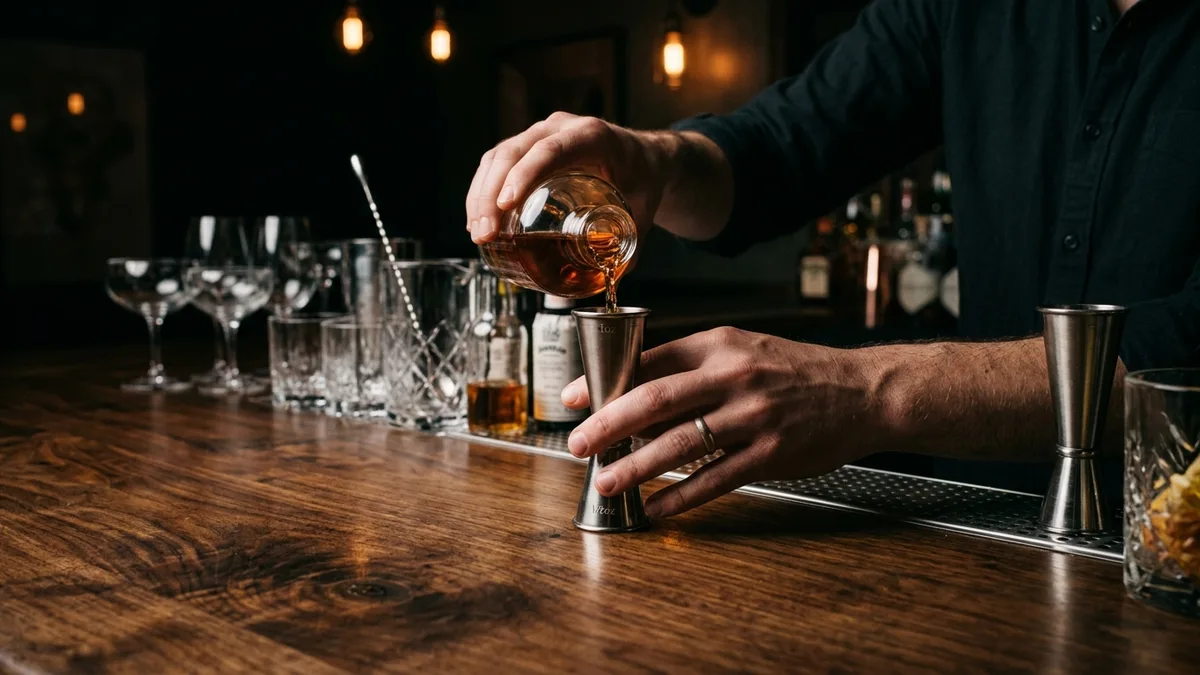
Table of Contents
20 sections1 oz liquid usually means one fluid ounce: approximately 29.57 mL in the US system, or about 30 mL for everyday cooking. You can also measure it as two US tablespoons, six US teaspoons, or one-eighth of a US customary cup.
That is a small amount, so your measuring tool matters. A large pitcher may have no marking low enough to help, while an ordinary eating spoon can hold an uncertain quantity. For a recipe calling for a single ounce of lemon juice, syrup, or another liquid, a marked miniature measuring cup or proper measuring spoons are easier to use.
Before pouring, check that the recipe means fluid ounces and uses US measurements. An imperial fluid ounce is slightly smaller, and an ounce by weight is a different type of measurement.
One Fluid Ounce at a Glance
The following equivalents apply to one US fluid ounce. The spoon and cup relationships are exact within the US customary system; metric figures are rounded as indicated.
| Unit | Equivalent to 1 US fl oz |
|---|---|
| Milliliters | Approximately 29.57 mL |
| US tablespoons | 2 tbsp |
| US teaspoons | 6 tsp |
| US customary cups | 1/8 cup |
| Liters | Approximately 0.02957 L |
For ordinary kitchen work, about 30 mL is a useful rounded amount. If you need a precise conversion, retain 29.5735295625 mL in your calculation and round only the final result.
How to Measure 1 oz Liquid With Kitchen Tools
Choose a tool with markings suited to a small quantity. Trying to estimate a low fill level in a large jug makes the task harder than it needs to be.
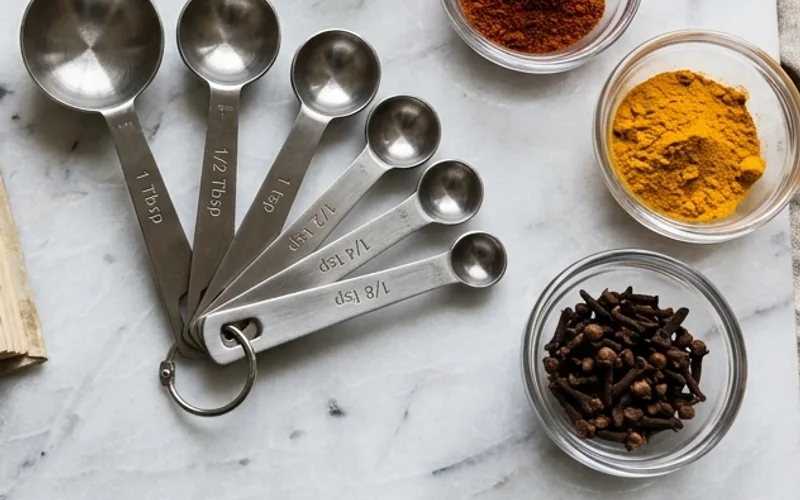
Use two measuring tablespoons
For a US recipe, fill a US tablespoon measure twice. Keep it level, fill it to the intended capacity without overflowing, and empty each spoonful into your mixing container.
Check the spoon’s markings if it belongs to a metric set. Two 15 mL tablespoons hold 30 mL, which is a close cooking approximation rather than exactly one US fluid ounce. If the spoon has another marked capacity, calculate from that value instead.
A spoon from your cutlery drawer is not a reliable substitute for a measuring tablespoon.
Use a small graduated liquid measure
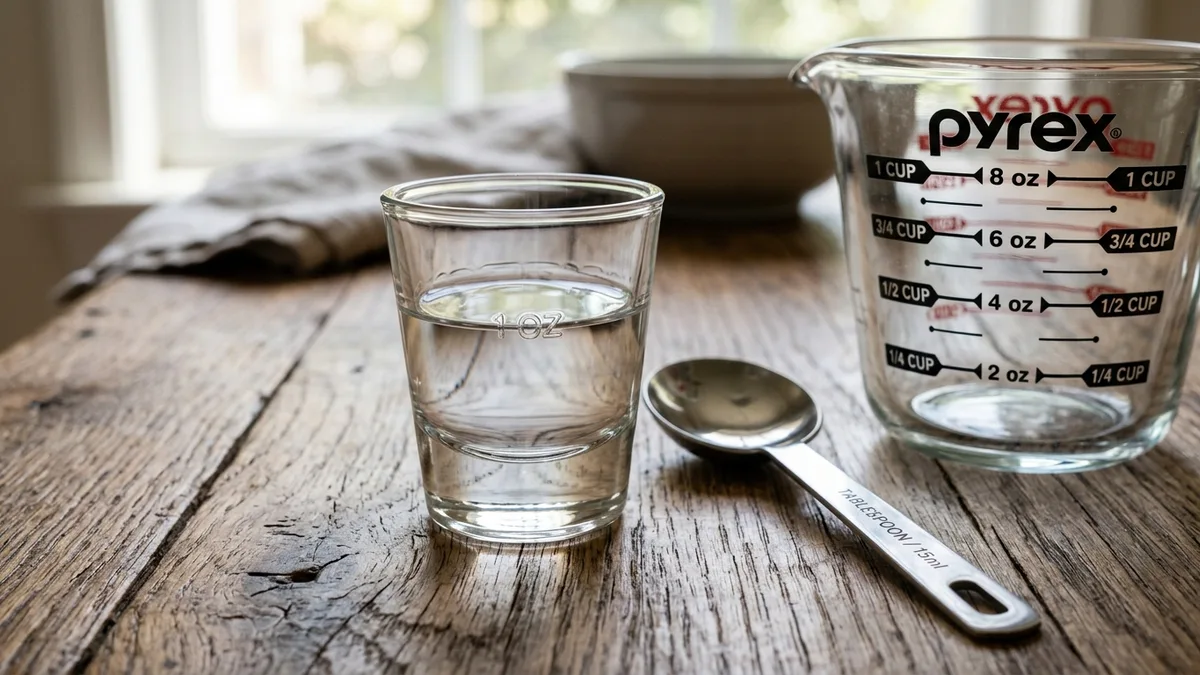
A small transparent measure with a 1 fl oz line lets you measure the quantity in one pour.
- Put the measure on a level surface.
- Add liquid slowly as you approach the line.
- Lower your eyes to the level of the marking.
- For water or a similar clear liquid, read the bottom of the curved surface, called the meniscus.
- Adjust the amount before transferring it.
Looking down from above can make the level appear different. A small measure with clear divisions is also easier to read than a large jug with widely spaced lines.
Use a clearly marked jigger
For mixing drinks, a jigger with a labeled 1 fl oz capacity or graduation can work well. Use the correct line or side rather than assuming the whole vessel holds one ounce.
A plain shot glass is useful only if its capacity or markings establish the amount you need. Its appearance alone does not tell you where a one-ounce pour ends.
Putting the Measurement to Work in a Recipe
Suppose a dressing recipe calls for 1 US fl oz of lemon juice. You can measure two US tablespoons directly into the bowl. If your tablespoon is marked 15 mL, two spoonfuls give a practical 30 mL approximation.
Now suppose you want to halve the recipe. The lemon juice becomes half a US fluid ounce, which is one US tablespoon. You can adjust the amount directly without converting through milliliters first.
For a larger batch, keep the original quantity in your calculation until the end. Multiplying a rounded amount repeatedly can move the result farther from the original recipe than rounding once after scaling.
With a thick ingredient such as syrup, allow it time to drain from the measure. Liquid left coating the tool does not make it into the bowl, even if the initial reading was correct.
When 30 mL Is Close Enough
The difference between 30 mL and one US fluid ounce is approximately 0.43 mL, or about 1.4%. For many ordinary cooking tasks, that difference is small enough for a practical approximation.
For a calculation requiring precision, use the defined US value:
Milliliters = US fluid ounces × 29.5735295625
With one fluid ounce as the input, the numerical result is simply 29.5735295625 mL.
Extra decimal places describe the conversion, not the accuracy of your kitchen tool. A measuring cup with coarse markings cannot physically measure every decimal shown by a calculator. Match the precision of the result to the task and the equipment available.
Check the System Before Using an International Recipe
One imperial fluid ounce equals approximately 28.41 mL, compared with approximately 29.57 mL for the US fluid ounce. That is a difference of about 1.16 mL per fluid ounce.
Use the recipe’s stated measurement system rather than assuming all ounce measurements mean the same thing. The tablespoon and cup equivalents above are US customary equivalents, so they should not automatically be applied to imperial measurements or differently sized metric utensils.
If an international recipe provides milliliters, measuring that stated amount directly can remove the need to interpret an unfamiliar ounce or spoon standard.
Match the Tool to the Liquid You Are Measuring
A small liquid measuring cup is convenient when the ingredient pours cleanly and the fill line is easy to see. Measuring spoons work well when the recipe uses US spoon quantities and you can transfer each spoonful without spilling. The best choice depends on how you will deliver the liquid into the recipe, not just how you will collect it.
For an opaque liquid, do not try to see through the contents to a line on the far side of a vessel. Use a measure with readable markings and view the level from the appropriate angle. For a sticky ingredient, a vessel with an accessible opening can be easier to empty than a narrow container.
Avoid measuring a visibly foamy ingredient immediately after vigorous mixing. Air bubbles can make the apparent level difficult to interpret. Allow the liquid to settle before reading its volume when the recipe permits that approach. The aim is to measure the liquid, rather than including an uncertain layer of foam in the reading.
Also consider the receiving container. Pouring from a broad cup into a narrow opening creates more opportunity for spills. A small spout or suitable funnel can help with transfer, but liquid left on that additional tool still has to reach the final container.
What to Do When Your Measure Has Only mL Marks
You do not need to buy another utensil just because a recipe uses fluid ounces. Convert the amount, then choose a sensible reading on the tool you already have.
For one US fluid ounce, 29.57 mL lies slightly below a 30 mL line. On a tool marked only every 5 mL, attempting to distinguish 29.57 from 30 would suggest more accuracy than the markings support. For ordinary cooking, measure the rounded 30 mL amount if that approximation suits the recipe.
If the task genuinely needs finer control, use a volume measure with smaller divisions. More digits on a calculator cannot compensate for a tool whose lowest useful mark is 50 mL. In that case, the mismatch is between the quantity and the equipment.
For repeated small pours, choose one measuring method and use it consistently. Alternating between a nominal ounce line and metric spoons can introduce a small change from one batch to the next, even when each method seems reasonable on its own.
Scaling a One-Ounce Ingredient for Several Batches
Imagine a marinade recipe that uses 1 US fl oz of vinegar per batch, and you want to prepare seven batches together. The required total is 7 US fl oz, approximately 207.01 mL.
If you instead round each batch to 30 mL first, seven batches use 210 mL. The difference is about 2.99 mL. That may be acceptable in a flexible marinade, but it explains why two reasonable approaches can yield different totals.
For a larger recipe, multiply the original one-ounce quantity by the batch count before converting. You can then measure the combined amount once, provided the receiving vessel is suitable. This reduces the number of individual spoonfuls you must count and transfer.
Do not assume that doubling the whole recipe is appropriate just because one ingredient is easy to double. Follow the recipe’s own instructions for preparation and cooking. The conversion tells you the ingredient quantity; it does not determine changes to cooking time or technique.
Separate Measuring Errors From Conversion Errors
If two attempts give noticeably different results, check the process before changing the conversion factor. A tilted measure, a missed spoonful, or liquid left behind can change the delivered quantity while the arithmetic remains correct.
A useful comparison is to measure one ounce twice using the same tool, placing it on the same flat surface each time. If the levels differ, work on the reading and pouring method. If they match but a second utensil disagrees, check whether the tools use US customary or rounded metric capacities.
This troubleshooting approach keeps you from “correcting” an accurate conversion to compensate for an inconsistent measuring method.
Frequently Asked Questions
What does 1 oz of liquid look like?
In US measurements, it is the amount held by two measuring tablespoons. It may form a shallow layer in a wide glass or a taller column in a narrow container. Because shape changes its appearance, use a marked measure instead of judging the amount by liquid height.
Can I use six teaspoons instead of two tablespoons?
Yes, six US measuring teaspoons equal one US fluid ounce. If your teaspoons are marked 5 mL, six hold 30 mL, giving a close approximation. Count each spoonful carefully; using two tablespoons involves fewer transfers and less opportunity to lose track.
Is a 1-ounce bottle always filled with one fluid ounce?
The phrase can describe a container’s capacity or a product’s stated contents. Check the full specification for “fl oz,” a milliliter equivalent, or a net-weight statement. A bottle’s outside size includes its walls and may include empty space, so appearance alone cannot establish the quantity inside.
Can I weigh a fluid ounce on a kitchen scale?
Only if you know the appropriate mass for that liquid volume. A scale’s ordinary “oz” setting measures mass, not fluid ounces. You need the liquid’s density to calculate a target weight; setting the display to 1.00 oz does not generally produce one fluid ounce.
Is there a fixed number of drops in one fluid ounce?
No. Drop size varies with the liquid, dropper opening, and dispensing conditions. Counting drops is therefore not a dependable way to measure an ounce unless the particular dispenser has a verified calibration. Use a graduated volume measure when you need a known amount.
Does one fluid ounce of oil occupy the same volume as water?
Yes, if both measurements use the same fluid-ounce system. One US fluid ounce describes a fixed volume regardless of the liquid. Oil and water can have different masses at that volume because their densities differ, but that does not change the volume conversion.
A Practical Way to Remember the Amount
For US recipes, think of 1 oz liquid as two measuring tablespoons or roughly 30 mL. Use a small graduated measure when you need a clear fill line, and check the utensil markings before substituting spoons. Accurate measuring starts with choosing a tool that can show the amount you need.
Oz to mL Editorial Team
Verified EditorialWritten and verified by our culinary and scientific measurement specialists. All formulas, charts, and conversions strictly reference NIST standard US Customary and Metric SI units.
Convert Fluid Ounces & Milliliters Instantly
Need quick calculations for cooking, hydration tracking, or chemistry? Our free converter updates in real time with high decimal accuracy.
Related Conversion Guides
 Kitchen Measurements
How Much Is 1 Ounce Liquid? mL, Cups & Pour Sizes
How much is 1 ounce liquid? See its volume in mL, tablespoons, and cups, how it compares with common pours, and what to check on labels.
 Reference Charts
Unit Conversion Chart for Everyday Measurements and Math
Use this unit conversion chart for length, weight, volume, area, speed, and temperature, with metric and US measurements, clear formulas, and worked examples.
 Bottle Conversions
600 ml to oz: Is a 600 mL Bottle the Same as 20 oz?
Convert 600 ml to oz: 20.29 US fluid ounces. Compare it with a 20 oz bottle, check imperial ounces, and find the right cup measurement for your recipe.