
mL to Pounds: Conversion Formula, Water Chart & Examples
Convert mL to pounds using the liquid's density. See a quick water conversion chart, a worked example, and how to calculate pounds for any substance.
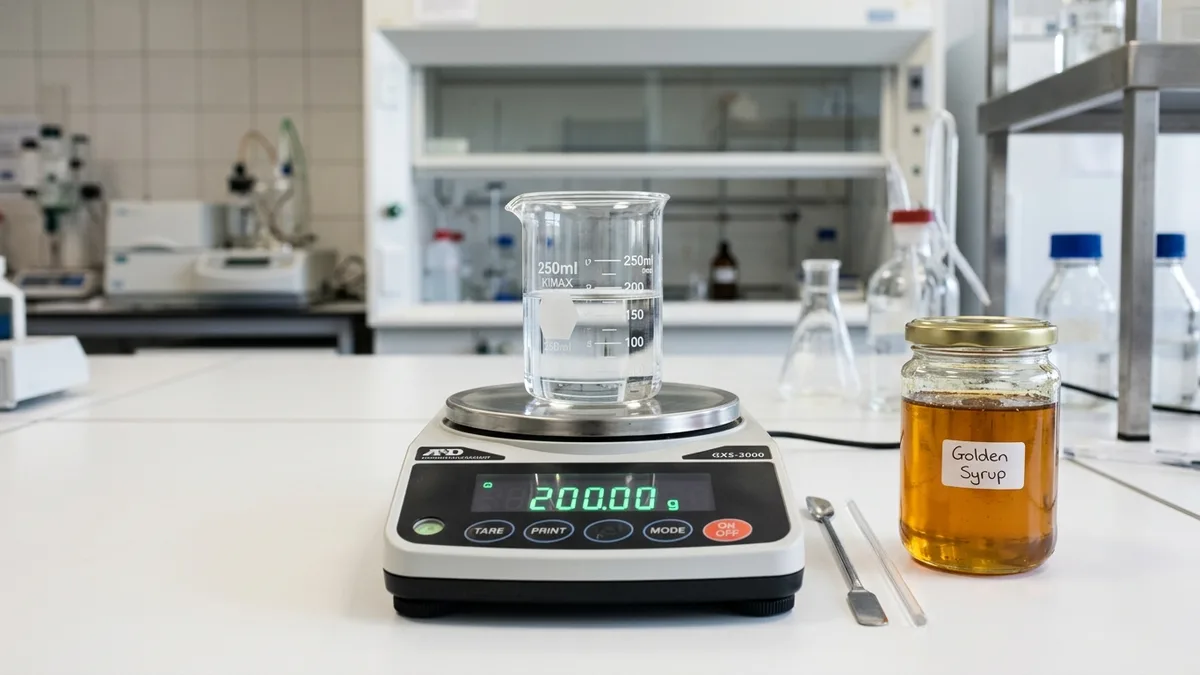
Table of Contents
18 sectionsTo convert mL to pounds, you need to know what substance the milliliters contain. Milliliters (mL) measure volume, while pounds (lb) measure mass. For water, 1,000 mL is about 2.205 lb if you use a density of approximately 1 gram per milliliter. The same volume of another liquid can weigh more or less.
That distinction matters when you are planning how much a container of liquid will weigh, scaling a recipe, or checking an ingredient in a tool. A calculator that asks only for milliliters must be assuming a particular substance, often water. Its answer may be wrong for your ingredient.
The useful approach is straightforward: identify the material, find an appropriate density, then calculate its mass in grams and convert grams to pounds. If you only need a quick estimate for water, the table below does the work for you.
Quick Reference: mL to Pounds for Water
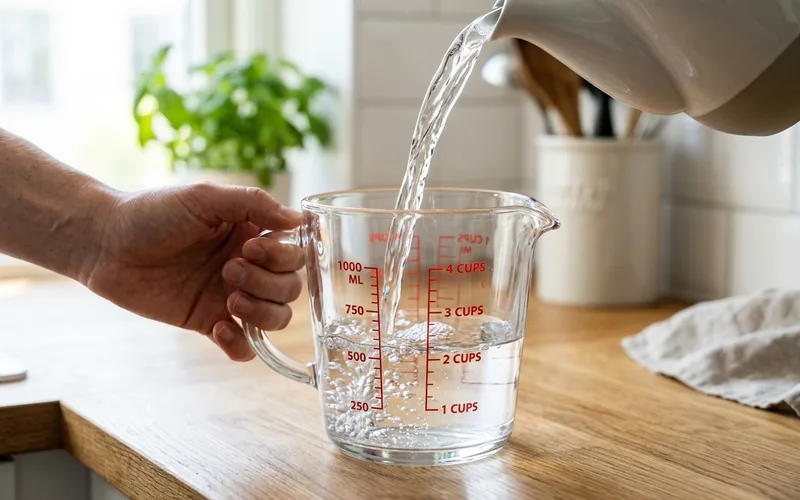
These values assume water has a density of 1 g/mL. They are practical estimates, not exact measured weights at every temperature.
| Water volume | Approximate mass in pounds |
|---|---|
| 100 mL | 0.220 lb |
| 250 mL | 0.551 lb |
| 500 mL | 1.102 lb |
| 750 mL | 1.653 lb |
| 1,000 mL | 2.205 lb |
| 2,000 mL | 4.409 lb |
The table describes the water alone. A full container weighs more because the bottle, lid, and any other contents add mass.
Why There Is No Single Conversion Factor
Imagine two containers that each hold 500 mL. One contains a substance with a density of 0.8 g/mL; the other contains a substance with a density of 1.2 g/mL. Their volumes match, but their masses are 400 g and 600 g respectively. The second is 50% heavier.
Density describes how much mass occupies a given volume. When density is expressed in grams per milliliter (g/mL), multiplying it by a volume in milliliters gives mass in grams. You can then express that mass in pounds.
This is why a search for “how many pounds is 500 mL?” needs one more detail: 500 mL of what? The water chart gives an answer only under its stated water assumption. A different ingredient requires its own density.
The mL to Pounds Formula
If density is given in g/mL, use:
Pounds = milliliters × density (g/mL) ÷ 453.59237
Here, 453.59237 is the number of grams in one avoirdupois pound. The units cancel in two steps:
- mL × g/mL = g. This finds the material’s mass in grams.
- g ÷ 453.59237 g/lb = lb. This changes grams into pounds.
For an example that does not depend on any particular product, suppose your material has a measured density of 0.90 g/mL and you have 600 mL of it:
600 mL × 0.90 g/mL = 540 g
540 g ÷ 453.59237 g/lb ≈ 1.19 lb
If another material had a density of 1.10 g/mL, that same 600 mL would have a mass of 660 g, or approximately 1.46 lb. These densities are hypothetical examples; use the density of your actual material for a real result.
A Faster Shortcut for Water
With water’s approximate density of 1 g/mL, the number of milliliters is approximately the number of grams. The general formula simplifies to:
Water mass (lb) ≈ volume (mL) ÷ 453.59237
For example, 500 mL of water has an estimated mass of 500 g:
500 ÷ 453.59237 ≈ 1.102 lb
You may see this rounded to 1.1 pounds. If you work with liters, the same estimate says one liter of water is about 2.205 pounds. Water’s actual density changes with temperature, so keep this as an estimate unless your task specifies conditions and requires more precise data.
How to Use a Converter for Another Ingredient
For a tool that offers a custom-density setting, check these inputs before pressing Convert:
- Volume: Enter the measured liquid amount in mL.
- Substance: Select the actual ingredient, or choose custom density.
- Density unit: Confirm the density is in g/mL before using the formula above.
- Output: Read the result as pounds of the contents, separate from the container.
If you have a density in kg/L, its numerical value is the same as in g/mL. For example, 0.90 kg/L equals 0.90 g/mL. A density supplied in other units must be converted before you put it into the formula.
Check whether the source gives density for the same mixture and temperature you are measuring. An oil blend, syrup, or prepared drink can differ from a generic value listed for a broad category. For an everyday kitchen task, weighing the measured amount directly is often simpler than hunting for a precise density.
Measure the Contents, Not the Bottle
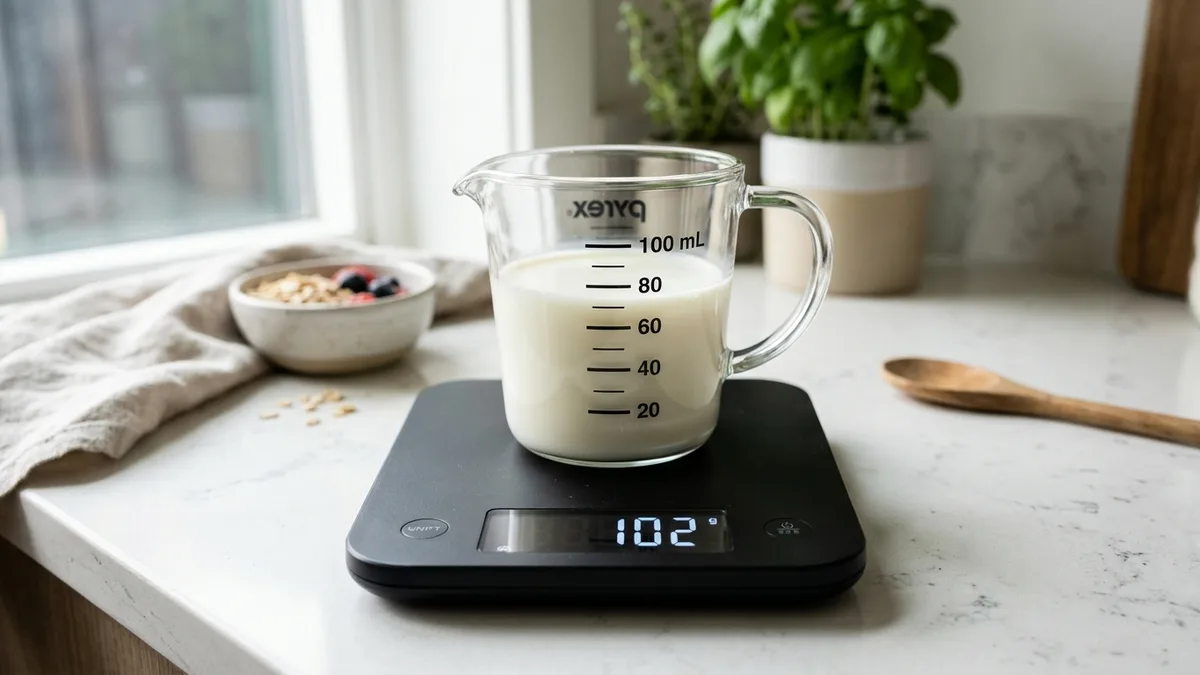
When you need the real mass rather than an estimate, use a scale and a marked volume measure together. Put an empty container on the scale and press tare to zero it. Measure the desired volume of liquid and add it to the container. Read its mass, using the scale’s pound setting if available.
This method accounts for the particular liquid you have. It also avoids accidentally including the container’s mass. Confirm whether the scale displays decimal pounds or pounds and ounces: 1.5 lb means one and a half pounds, while 1 lb 5 oz means a different amount.
For small volumes, a grams reading may be easier to interpret. Divide the measured grams by 453.59237 to obtain pounds.
Entering Density in the Right Units
A density number is incomplete without its unit. A specification of 900 kg/m³ does not mean 900 g/mL. To convert kilograms per cubic meter into grams per milliliter, divide by 1,000. The example therefore becomes 0.900 g/mL.
Putting 900 directly into a field expecting g/mL would make the answer one thousand times too large. This kind of input mistake can look like a problem with the mL to lbs formula when the formula itself is working correctly.
For a hypothetical 350 mL sample with a density of 900 kg/m³, first change the density to 0.900 g/mL. Then calculate 350 × 0.900 = 315 g, followed by 315 ÷ 453.59237 ≈ 0.694 lb.
Write the density unit beside its value when copying it from a product sheet. If the document instead provides specific gravity, check its reference conditions before treating it as density. Specific gravity is a ratio, while density carries a mass-per-volume unit.
Converting the Result Into Pounds and Ounces
Some scales and forms accept decimal pounds, while others split the result into pounds and ounces. To convert a decimal-pound result, keep the whole pounds and multiply the remaining fraction by 16.
For example, an approximate result of 2.75 lb becomes 2 lb 12 oz:
0.75 × 16 = 12 oz
A result below one pound uses the same method. 0.625 lb is 10 oz because 0.625 × 16 = 10. These are standard weight ounces, not fluid ounces.
Keep more digits until the final display if you are converting a calculated result. Rounding pounds first and then converting that rounded number to ounces can produce a slightly different last digit than converting directly from the original gram value.
Estimating a Filled Container’s Total Weight
The conversion formula gives the mass of the material alone. For a filled bottle, add the empty container’s mass after calculating the contents.
Suppose a hypothetical container holds 900 mL of water, using the kitchen estimate of 1 g/mL, and the empty container plus lid weighs 120 g. The water contributes about 900 g, making the combined mass 1,020 g, or approximately 2.25 lb.
If you also place the bottle in a box, that box and any packing material add further mass. A contents-only result should therefore not be treated as the weight of a complete parcel. Weigh the finished package when you need its actual total.
Keep assumptions visible in your notes. “900 mL water, density assumed 1 g/mL, container 120 g” is much easier to audit than a standalone number such as “2.25 lb.” Another person can then see which part was measured and which part was estimated.
How Much Can a Density Estimate Change the Answer?
For a fixed volume, a percentage change in density produces the same percentage change in calculated mass. If your density estimate is 2% too high, your estimated pounds will also be 2% too high, before considering any separate volume-measurement error.
Consider 800 mL of a hypothetical liquid whose density might be between 0.95 and 1.05 g/mL. The calculated mass ranges from 760 to 840 g, or approximately 1.68 to 1.85 lb. Reporting a single answer to many decimal places would hide the uncertainty in the input.
For an informal estimate, a sensible range may be more honest and useful than a long decimal. For a reproducible recipe or material calculation, improve the density information or weigh the sample directly. More precise input is what improves the result.
Frequently Asked Questions
How many pounds is 1 mL of water?
Assuming a density of 1 g/mL, 1 mL of water has a mass of approximately 0.002205 lb. That is a very small fraction of a pound. Multiply this estimate by your volume in milliliters to get a quick water-only answer, or use the formula with a more appropriate density when precision matters.
Is 500 mL half a pound?
No. Under the usual water estimate, 500 mL has a mass of about 1.102 lb. Half a pound of water would occupy about 227 mL under the same density assumption. For another liquid, both figures change with its density.
How much does 1,000 mL of water weigh in pounds?
At an assumed density of 1 g/mL, 1,000 mL has a mass of 1,000 g, or approximately 2.205 lb. That is the water’s mass before adding the weight of a bottle. It is an estimate because the precise density of water depends on conditions such as temperature.
Can I convert milliliters of oil to pounds using the water chart?
The water chart assumes 1 g/mL, so it is unsuitable as a precise oil conversion. Find a density for the particular oil at the relevant temperature, then multiply the milliliters by that density and divide by 453.59237. You can also measure the volume and weigh it directly.
How many mL are in one pound?
That depends on the substance. If you assume water has a density of 1 g/mL, one pound corresponds to approximately 453.59 mL of water. For a different material, divide 453.59237 g by its density in g/mL to calculate the corresponding volume.
Why do two mL to lb calculators give different answers?
They may use different assumed substances, densities, temperatures, or rounding rules. Check the setting beside each result. If one calculator assumes water and the other uses a custom ingredient density, they are answering different questions even though you entered the same mL value.
Use the Density That Fits Your Material
The reliable way to convert mL to pounds is to multiply volume by the material’s density, then divide the grams by 453.59237. For a quick water estimate, 1,000 mL is about 2.205 lb. For anything else, enter the right density or weigh the measured amount directly.
Oz to mL Editorial Team
Verified EditorialWritten and verified by our culinary and scientific measurement specialists. All formulas, charts, and conversions strictly reference NIST standard US Customary and Metric SI units.
Convert Fluid Ounces & Milliliters Instantly
Need quick calculations for cooking, hydration tracking, or chemistry? Our free converter updates in real time with high decimal accuracy.
Related Conversion Guides
 Volume to Weight
How Many Grams Is 100 ml? Water & Ingredient Chart
How many grams is 100 ml? Water is about 100 g, but other ingredients differ. See a clear 100 mL to grams chart and the density formula.
 Reference Charts
Unit Conversion Chart for Everyday Measurements and Math
Use this unit conversion chart for length, weight, volume, area, speed, and temperature, with metric and US measurements, clear formulas, and worked examples.
 Bottle Conversions
600 ml to oz: Is a 600 mL Bottle the Same as 20 oz?
Convert 600 ml to oz: 20.29 US fluid ounces. Compare it with a 20 oz bottle, check imperial ounces, and find the right cup measurement for your recipe.