
How Many Grams Is 100 ml? Water & Ingredient Chart
How many grams is 100 ml? Water is about 100 g, but other ingredients differ. See a clear 100 mL to grams chart and the density formula.
Table of Contents
18 sectionsHow many grams is 100 ml? If you mean water, about 100 grams. That is the quick answer most people need for a recipe. For milk, oil, syrup, or flour, the number changes because the same volume of each ingredient has a different mass.
Milliliters (mL) describe the space an ingredient occupies. Grams (g) describe its mass, which a kitchen scale displays. To move from one to the other, you need the ingredient’s density: its mass per unit of volume. A converter showing a single answer for every ingredient is silently making an assumption.
The difference may be small for milk and much larger for oil or a dry ingredient. Use the chart below for a practical estimate, then check the explanation when your recipe, product, or measuring method calls for more precision.
A Quick 100 mL to Grams Ingredient Chart
These are estimated masses for 100 mL. The density values are representative food data, not guaranteed weights for every brand or measuring condition.
| Ingredient | Density used | Estimated mass of 100 mL |
|---|---|---|
| Water, kitchen estimate | 1.00 g/mL | 100 g |
| Liquid milk | 1.03 g/mL | 103 g |
| Olive oil | 0.918 g/mL | 91.8 g |
| Maple syrup | 1.32 g/mL | 132 g |
| Wheat flour, one listed bulk-density value | 0.521 g/mL | 52.1 g |
Water is included as a convenient kitchen estimate. The other density values are from the FAO/INFOODS food density database. Flour needs extra care: the same database lists several different densities for wheat flour, so 52.1 g is one example, not a universal flour conversion. The amount of air between particles and how firmly you fill a measuring container affect its mass.
Why 100 mL of Water Is Close to 100 g
Water’s density is near 1 g/mL under everyday conditions. Multiplying 100 mL by that density gives about 100 g, a useful approximation for cooking and basic conversion questions.
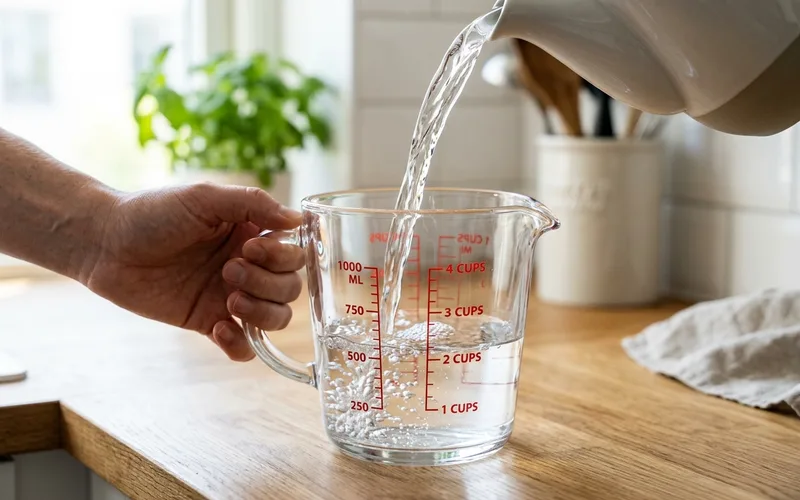
It is not an exact equality at every temperature. NIST gives a water density of about 0.9982 g/mL at 20°C. At that temperature, 100 mL of water has a mass of approximately 99.82 g, based on that density.
The difference between 99.82 g and a rounded 100 g is about 0.18 g. A kitchen recipe will rarely need you to account for it. In a controlled measurement, use a density appropriate to the water’s actual temperature and conditions.
The Formula for Any 100 mL Ingredient
When density is stated in g/mL, the calculation is:
Grams = milliliters × density (g/mL)
For the specific volume in this article, that becomes:
Grams in 100 mL = 100 × density (g/mL)
Take liquid milk from the table. Using 1.03 g/mL as the listed estimate:
100 mL × 1.03 g/mL = 103 g
The milliliters cancel, leaving grams. If your product’s density differs, replace 1.03 with its stated value. A density supplied in kg/L has the same numerical value as one in g/mL; convert any other density unit before applying this version of the formula.
What Changes When the Ingredient Is Flour?
It is tempting to treat a 100 mL flour measure like a 100 mL water measure. The container holds the same volume, but flour has air spaces between its particles, and the amount packed into that space varies.
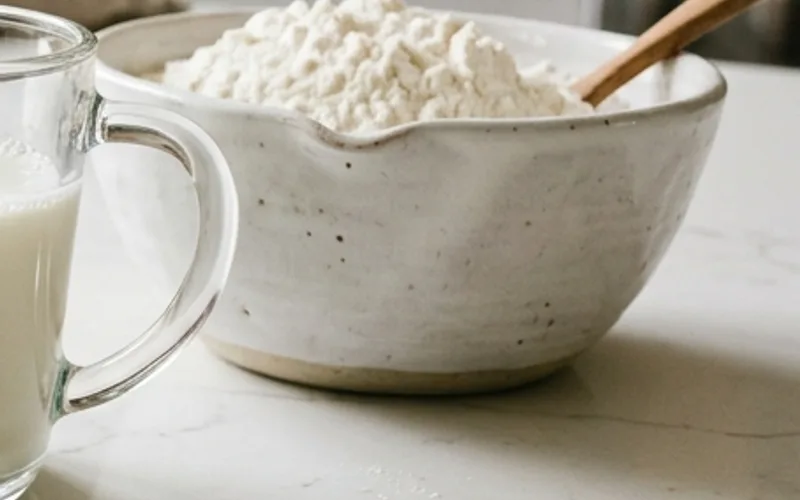
The chart’s 52.1 g result comes from multiplying 100 mL by one published wheat-flour bulk density of 0.521 g/mL. Other published flour densities differ. Scooping, shaking, or pressing flour can change what your own 100 mL measure weighs, even when the ingredient name remains the same.
If a baking recipe specifies grams of flour, a scale gives you the target mass directly. A volume estimate is useful when you have no scale, but it cannot promise the same gram result across different flour types and measuring methods.
How to Check 100 mL With a Scale
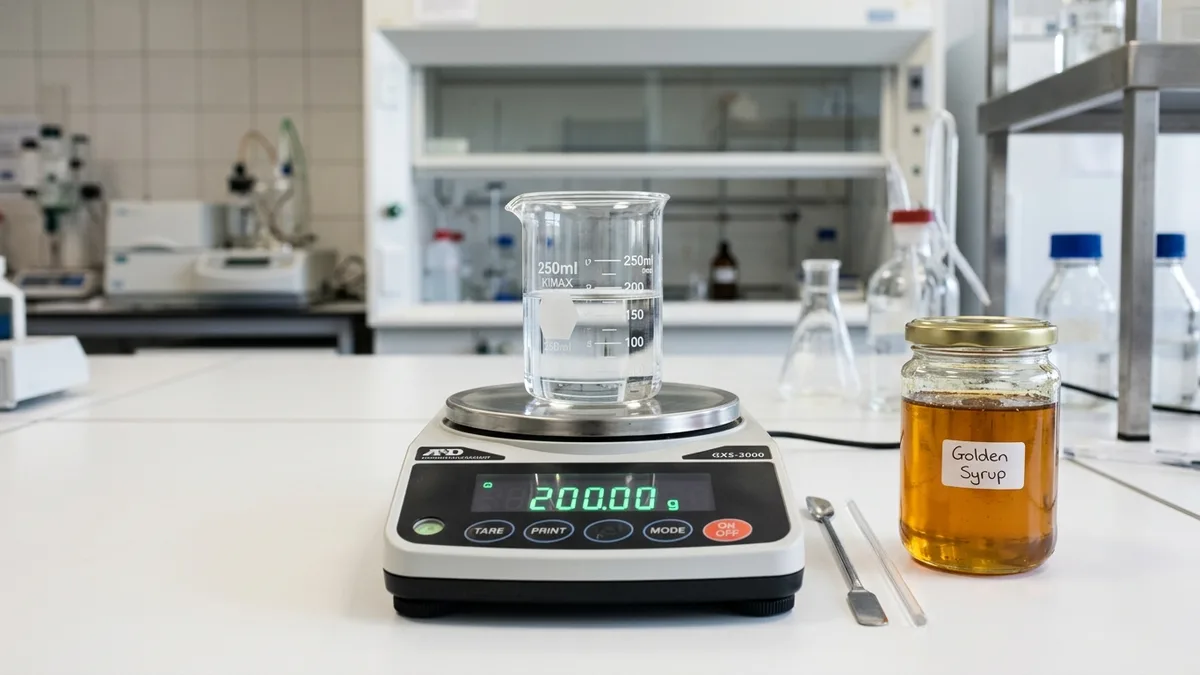
You can find the mass of the specific ingredient in your kitchen without guessing its density:
- Put an empty container on the scale and set the reading to zero using tare.
- Measure 100 mL of the ingredient with a suitable graduated measure.
- Transfer the full amount to the container and read the result in grams.
For a pourable liquid, a measure with visible mL markings makes the volume easier to check. For a dry ingredient, use a consistent fill method if you plan to repeat the measurement. Oil or syrup left behind on the measuring vessel will reduce what reaches the scale, so allow it to drain if you are comparing the two readings.
The scale measures what actually entered the container. A published density gives an estimate for what should weigh a certain amount under its stated assumptions.
Do Labels Mean “Per 100 mL” or “Per 100 g”?
Look at the unit printed next to a number before using it in a recipe or comparison. Per 100 mL refers to a fixed volume of a product. Per 100 g refers to a fixed mass. The portions coincide numerically only if that product has a density of 1 g/mL.
For example, using the chart’s milk estimate, a 100 mL portion has a mass near 103 g. A 100 g portion of that same milk would occupy a little less than 100 mL. The values on two differently labeled portions therefore should not be treated as identical without converting the serving amount first.
This distinction is especially useful when a food package states a volume but your recipe asks for grams. Identify the product, then use its density or weigh the required portion.
Checking Your Own Ingredient With a 100 mL Sample
A measured 100 mL sample is a convenient way to estimate density because dividing its gram reading by 100 is simple. If a hypothetical sauce sample weighs 112 g after subtracting the container, its estimated density is 1.12 g/mL.
You could use that estimate for another portion of the same sauce. A 40 mL portion would have an estimated mass of 44.8 g, while 250 mL would be approximately 280 g. These figures assume the mixture stays uniform and the measuring conditions remain comparable.
For a mixture that separates, stir it as the recipe directs before sampling. Otherwise, a sample drawn mainly from one layer may not represent the whole mixture. Avoid including an uncertain layer of foam when reading the 100 mL mark.
Repeating the measurement can show whether your method is consistent. If successive samples weigh noticeably different amounts, check the fill level, mixing, transfer losses, and scale setup before averaging the readings. An average does not automatically correct a repeated measuring mistake.
What a Scale’s “mL” Setting Can and Cannot Tell You
An ordinary kitchen scale senses the load on its platform. When it displays milliliters, it generally calculates volume from the measured mass using an assumed density or a named liquid mode. Read the device instructions to find out which assumption applies.
For example, a water-based setting may interpret approximately 100 g as 100 mL. That does not establish that 100 g of oil, syrup, or flour also occupies 100 mL. Changing the screen’s unit does not directly measure the space taken up by a different ingredient.
To check an ingredient whose density is unknown, use grams on the scale and measure volume separately. You then have two actual observations to work with: the amount of space filled and the mass of the contents. That is more informative than relying on an unexplained volume setting.
Turning a “Per 100 mL” Value Into “Per 100 g”
The serving basis matters when comparing product information. Once you know density, you can change a value stated per 100 mL into its equivalent per 100 g for the same uniform product.
Suppose a hypothetical product lists 12 units of a measured component per 100 mL, and its density is 1.20 g/mL. That 100 mL portion weighs 120 g. To express the component amount per 100 g, calculate:
12 × 100 ÷ 120 = 10 units per 100 g
The product itself has not changed. You are describing a smaller portion of it. In general, divide the per-100-mL value by the density in g/mL to obtain the corresponding per-100-g value.
Use product-specific density where possible, and remember that label values may already be rounded. Do not treat the extra decimal places from this calculation as more precise than the original information.
Temperature and Measuring Method Belong With the Result
The statement “100 mL weighs 100 g” leaves out the ingredient and conditions. A more useful record says what you measured, how you filled the vessel, and whether the result was a direct scale reading or a calculation.
For a dry ingredient, record whether it was loosely filled, leveled, or compacted. For a liquid, note any relevant temperature condition supplied with the density. These details help explain differences between a published table and your own kitchen result.
You do not need a lengthy laboratory record for an ordinary recipe. A short note such as “100 mL of this sauce weighed 112 g, mixed before measuring” is enough to preserve the assumption. That gives the number a practical meaning the next time you use it.
Frequently Asked Questions
Is 100 ml always equal to 100 grams?
No. That is a convenient approximation for water because its density is near 1 g/mL. For other ingredients, multiply 100 by the ingredient’s density in g/mL. Using the representative figures above, 100 mL of olive oil is about 91.8 g, while 100 mL of maple syrup is about 132 g.
How many grams is 100 ml of milk?
Using the FAO/INFOODS figure of 1.03 g/mL for liquid milk, 100 mL has an estimated mass of 103 g. Milk composition and measurement conditions can vary, so treat this as a practical estimate. A scale provides the mass of the particular milk you poured.
How much does 100 ml of olive oil weigh?
Using a listed olive-oil density of 0.918 g/mL, 100 mL has an estimated mass of 91.8 g. If an olive-oil conversion tool uses 0.91 g/mL instead, it will display about 91 g. Check the density assumption before comparing two calculated answers.
How many grams is 100 ml of flour?
There is no single reliable figure for every flour or measuring method. At one FAO/INFOODS listed wheat-flour bulk density of 0.521 g/mL, the calculation gives 52.1 g. Other listed values differ, and packing flour into the measure changes its mass. Weigh flour when a recipe gives a gram amount.
Does 100 ml equal 0.1 liter?
Yes. 1,000 mL = 1 liter, so 100 mL = 0.1 L. Both express the same volume. Converting that volume into grams still requires a density or a specified substance; moving between milliliters and liters alone does not provide a mass.
How do I convert 100 grams back to ml?
Divide the mass by the ingredient’s density in g/mL: mL = grams ÷ density. At a density of 1.03 g/mL, 100 g of milk would occupy about 97.1 mL. This is a different question from the mass of 100 mL of milk, which is approximately 103 g under the same assumption.
Keep the Ingredient in the Answer
When someone asks how many grams is 100 ml, about 100 g of water is a useful starting point. For anything else, multiply 100 mL by that ingredient’s density in g/mL or weigh the measured amount. State the ingredient alongside the answer so the number remains meaningful.
Oz to mL Editorial Team
Verified EditorialWritten and verified by our culinary and scientific measurement specialists. All formulas, charts, and conversions strictly reference NIST standard US Customary and Metric SI units.
Convert Fluid Ounces & Milliliters Instantly
Need quick calculations for cooking, hydration tracking, or chemistry? Our free converter updates in real time with high decimal accuracy.
Related Conversion Guides
 Volume to Weight
mL to Pounds: Conversion Formula, Water Chart & Examples
Convert mL to pounds using the liquid's density. See a quick water conversion chart, a worked example, and how to calculate pounds for any substance.
 Reference Charts
Unit Conversion Chart for Everyday Measurements and Math
Use this unit conversion chart for length, weight, volume, area, speed, and temperature, with metric and US measurements, clear formulas, and worked examples.
 Bottle Conversions
600 ml to oz: Is a 600 mL Bottle the Same as 20 oz?
Convert 600 ml to oz: 20.29 US fluid ounces. Compare it with a 20 oz bottle, check imperial ounces, and find the right cup measurement for your recipe.