
1oz Olive Oil to ml: Weight vs Fluid Ounce Explained
Convert 1 oz of olive oil to mL correctly. See why 1 fluid ounce is 29.57 mL while 1 ounce by weight is about 31 mL, with examples for recipes.
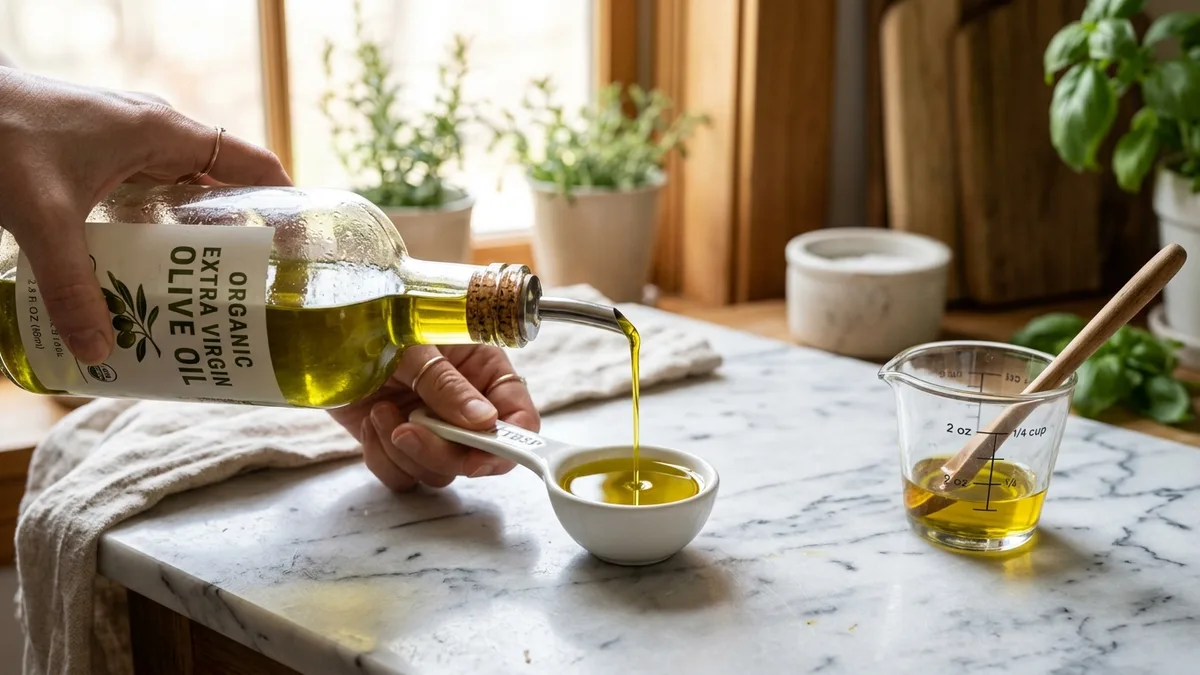
Table of Contents
18 sectionsFor 1oz olive oil to ml, check whether the ounce measures volume or weight. One US fluid ounce (1 fl oz) of olive oil is 29.57 mL. One ounce of olive oil by weight is approximately 31 mL, depending on the oil’s density and temperature. Those are two different measurements, even though both may be called “an ounce” in a kitchen.
The label or recipe gives the best clue. “Fl oz” points to a liquid-volume measure. An instruction to weigh the oil, or a scale reading in “oz,” points to mass. Choosing the right interpretation matters when you switch from a scale to a milliliter-marked jug.
Olive oil also makes the distinction easier to notice than water does. Because it is less dense than water, an ounce of olive oil by weight needs a little more space than one US fluid ounce provides. Here is how to work out the amount your recipe actually needs.
Quick Answer: Two Possible Results
| What “1 oz” means | Olive oil to measure |
|---|---|
| 1 US fluid ounce (fl oz), a volume | 29.57 mL |
| 1 ounce by weight (oz), a mass | About 31 mL using an estimated density of 0.91 g/mL |
If a product states “1 fl oz,” use the first row. If a recipe supplies one ounce as a weight and you can only measure by volume, use the second row as an approximation. Neither result depends on olive oil’s calories or nutritional composition; this is a question about volume and mass.
Why an Ounce of Olive Oil Has Two Answers
An ounce by weight describes how much matter you have. A fluid ounce describes how much space the oil takes up. A kitchen scale can show the first; a measuring jug can show the second.
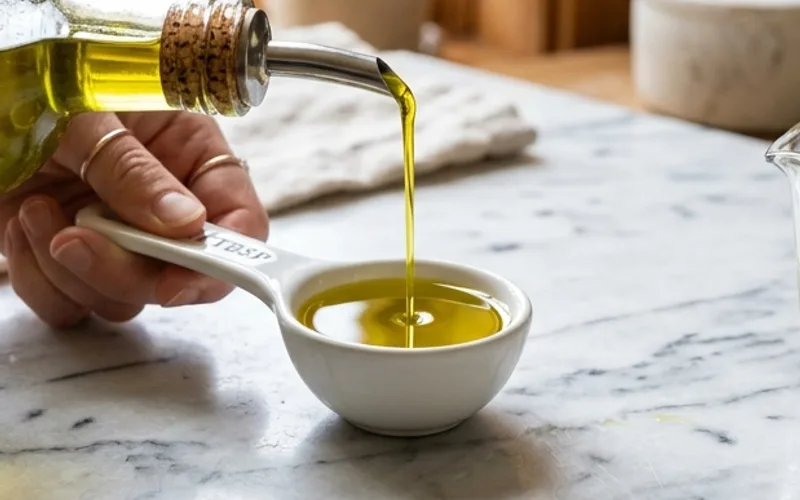
Olive oil’s density connects them. Density tells you the mass of a given volume, often expressed in grams per milliliter (g/mL). Around room temperature, roughly 0.91 g/mL is a practical estimate for olive oil. That means a milliliter of olive oil has a mass near 0.91 gram. Actual density can vary, so a weight-to-volume result is an estimate unless you know the density of your particular oil.
The distinction applies whether the bottle says olive oil or extra virgin olive oil. Its specific density may differ, but a fluid ounce remains the same volume. In a kitchen recipe, it is usually more useful to check the unit than to guess the oil’s density from its name.
Convert One Weight Ounce of Olive Oil to mL
One standard ounce of mass equals 28.349523125 grams. To find the volume from a weight, divide the mass by the oil’s density:
Volume (mL) = mass (g) ÷ density (g/mL)
For a clearly stated example, assume the olive oil has a density of 0.91 g/mL:
28.349523125 g ÷ 0.91 g/mL ≈ 31.15 mL
So, for ordinary kitchen use, about 31 mL represents one ounce of olive oil by weight. You may see slightly different figures, such as 31.0 or 31.2 mL, because the source used another reasonable density estimate. A value printed to two decimal places does not mean every bottle of olive oil has exactly that density.
For a more precise task, measure the actual density or follow the weight stated in the recipe. A scale displaying grams lets you use 28.35 g directly and skip the estimated volume conversion.
Convert One Fluid Ounce of Olive Oil to mL
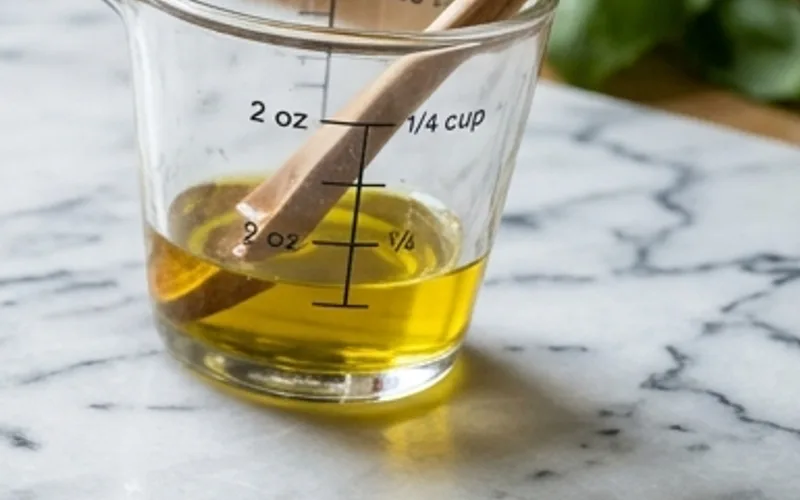
If the measurement is 1 US fl oz, olive oil’s density is irrelevant to the milliliter answer. Both fluid ounces and milliliters measure volume:
1 US fl oz = 29.5735295625 mL ≈ 29.57 mL
That holds for any liquid measured in US fluid ounces. For a quick US recipe, roughly 30 mL is often a convenient rounded measure.
The figure would change if the source uses an imperial fluid ounce, which is about 28.41 mL. Check the stated system in an older or international recipe. A US volume conversion should not silently be applied to an imperial quantity.
Which Number Should You Use in a Recipe?
Suppose a baking recipe tells you to add 1 oz of olive oil by weight. If you have a scale, place your mixing bowl on it, zero the display, and pour until it reads 1 oz or about 28.35 g. If you only have a metric jug, use about 31 mL as a kitchen estimate.
Now suppose a bottle lists a serving as 1 fl oz, or a recipe explicitly calls for 1 fluid ounce. Measure 29.57 mL, or approximately 30 mL for everyday cooking. Pouring the 31 mL weight-based estimate would give a little more oil than the stated fluid volume.
If an instruction simply says “1 oz olive oil,” look for a nearby gram equivalent, milliliter equivalent, or the author’s general recipe convention. When that context is unavailable, make your assumption explicit rather than treating 29.57 mL and 31 mL as interchangeable exact results.
A Small Conversion Chart for Weight Ounces
The following table converts ounces of olive oil by weight into an estimated volume. Every value assumes the same density of 0.91 g/mL. It does not convert fluid ounces.
| Olive oil by weight | Approximate volume |
|---|---|
| 1/2 oz | 15.58 mL |
| 1 oz | 31.15 mL |
| 2 oz | 62.31 mL |
| 4 oz | 124.61 mL |
If your source provides the oil’s actual density, use it in the formula instead of the table’s estimate. For a volume written in fl oz, use a fluid-ounce-to-milliliter conversion regardless of the type of oil.
How Much Does the Density Assumption Matter?
The estimate of 0.91 g/mL makes the weight-to-volume calculation easy to follow, but it is not an exact specification for every olive oil. To see the effect, compare it with a hypothetical density of 0.92 g/mL for the same one-ounce mass.
At 0.91 g/mL, 28.349523125 g occupies approximately 31.15 mL. At 0.92 g/mL, it occupies approximately 30.81 mL. The difference is about 0.34 mL.
This comparison illustrates sensitivity to density; it does not establish a guaranteed density range for a particular bottle. If a supplier provides suitable product data, use that value. Otherwise, keep the answer qualified as an estimate.
For a kitchen jug with widely spaced markings, the difference between these estimates may be smaller than what you can reliably read. A scale is useful when the recipe’s starting instruction is a weight because it removes the need to estimate the oil’s volume at all.
Adding Olive Oil Directly to a Mixing Bowl
For a recipe written by weight, you can place the bowl containing the other ingredients on the scale and tare it before adding the oil. The zeroed display then tracks only the newly added oil, provided the scale can handle the bowl and its contents.
Pour slowly as the reading approaches 28.35 g for one standard ounce. A scale displaying whole grams cannot show that exact decimal, so use the rounding appropriate to the recipe and equipment. Do not mistake the display’s number of digits for a guarantee of measurement accuracy.
This method also avoids leaving some oil in a separate measuring cup. When you measure oil in one vessel and pour it into another, the first vessel may retain a coating. The recipe receives what reaches the bowl, not necessarily everything initially measured.
If you overshoot, removing oil from an otherwise empty bowl is straightforward. Once it has mixed into other ingredients, removing a spoonful removes some of those ingredients too. Approaching the target with a controlled pour is easier than correcting a mixed recipe afterward.
Keeping a Dressing Ratio Consistent
Consider a hypothetical dressing mixed at three parts olive oil to one part vinegar by volume. If you use 1 US fl oz of oil, the matching vinegar amount is one-third US fl oz, or approximately 9.86 mL.
Both parts of that ratio use volume. If you instead weigh one ounce of olive oil and pair it with one-third fluid ounce of vinegar, the oil occupies about 31.15 mL under the 0.91 g/mL assumption. You have changed the intended volume ratio slightly.
For a flexible dressing, you may prefer adjusting by taste. For recording a recipe so someone else can reproduce it, keep the basis explicit: either list all relevant volumes or specify the ingredient weights. Mixing weight ounces and fluid ounces without naming them makes the instructions harder to follow.
A note such as “oil measured in US fluid ounces” is enough to explain why your milliliter amount is 29.57 rather than approximately 31. The distinction belongs in the recipe, not just in the calculation behind it.
Recording the Conversion for Future Use
If you save a conversion in a recipe notebook, include three details: the original amount, the kind of ounce, and the resulting metric amount. For a weight-based estimate, add the density assumption as well.
For example, write “1 oz by weight = 28.35 g; about 31.15 mL at 0.91 g/mL.” For a volume instruction, write “1 US fl oz = about 29.57 mL.” These notes prevent the two answers from becoming interchangeable when you return to the recipe later.
Frequently Asked Questions
Is 1 oz of olive oil the same as 30 mL?
It is close if “oz” means a US fluid ounce: 1 US fl oz is approximately 29.57 mL. If the ounce is a weight, an estimated volume is closer to 31 mL at 0.91 g/mL. Check whether the recipe says “fl oz” or asks you to weigh the ingredient.
How many tablespoons are in one ounce of olive oil?
One US fluid ounce is exactly two US customary tablespoons. An ounce of olive oil by weight takes up approximately 31.15 mL under the density assumption used here, or about 2.1 US customary tablespoons. Specify which ounce you mean before using a spoon conversion.
How many grams are in 1 fl oz of olive oil?
At an assumed density of 0.91 g/mL, multiply 29.5735295625 mL by 0.91 g/mL. The result is about 26.91 g. This is an estimate for olive oil, not the definition of a fluid ounce. The actual mass depends on the oil’s density.
Does extra virgin olive oil change the fluid-ounce conversion?
No. One US fluid ounce of extra virgin olive oil still occupies approximately 29.57 mL. A change in oil type or density affects the conversion from weight ounces to milliliters, since that calculation asks how much space a particular mass occupies.
Why does my olive oil converter show 31.2 mL?
It probably treats “oz” as an ounce by weight and uses an estimated olive oil density near 0.91 g/mL. Dividing 28.35 g by that density gives about 31.2 mL when rounded to one decimal place. A converter using US fluid ounces instead will show about 29.57 mL.
Can I measure one weight ounce of olive oil on a liquid jug?
You can approximate it with about 31 mL if a density near 0.91 g/mL suits the task. A jug measures volume, so it cannot directly confirm a specified weight. If accuracy matters for the recipe, a scale is the more direct way to measure 1 oz by weight.
Read the Unit Before You Pour
For 1oz olive oil to ml, the useful answer depends on the original unit: 29.57 mL for one US fluid ounce, or about 31 mL for one ounce by weight under the stated density estimate. Once you identify which ounce your recipe or label uses, you can measure the oil without mixing a volume instruction with a weight calculation.
Oz to mL Editorial Team
Verified EditorialWritten and verified by our culinary and scientific measurement specialists. All formulas, charts, and conversions strictly reference NIST standard US Customary and Metric SI units.
Convert Fluid Ounces & Milliliters Instantly
Need quick calculations for cooking, hydration tracking, or chemistry? Our free converter updates in real time with high decimal accuracy.
Related Conversion Guides
 Reference Charts
Unit Conversion Chart for Everyday Measurements and Math
Use this unit conversion chart for length, weight, volume, area, speed, and temperature, with metric and US measurements, clear formulas, and worked examples.
 Bottle Conversions
600 ml to oz: Is a 600 mL Bottle the Same as 20 oz?
Convert 600 ml to oz: 20.29 US fluid ounces. Compare it with a 20 oz bottle, check imperial ounces, and find the right cup measurement for your recipe.
 Bottle Conversions
750 ml to oz: US Fluid Ounces, UK Ounces & Bottle Size
Convert 750 ml to oz accurately: 25.36 US fluid ounces or 26.40 UK imperial fluid ounces. See the formula, rounding, cups, and bottle portions.